Lost Sydney: Woollhara Station
Location: Eastern Suburbs, SydneyWoollahra Station is possibly the best example of a 'ghost station' in the entire metropolitan area of Sydney. The sight of a largely completed husk of a heavy railway station on the Eastern Suburbs railway line, surrounded by over-hanging trees, expensive inner-Sydney properties and curving and pleasant suburban streets is unusual for Sydney.
The building of the Eastern Suburbs Railway line was one of the slowest projects ever embarked upon by the NSW State Government. Tunnelling for the branch line south from St. James station to Bondi commenced in 1917, but the project remained uncompleted for decades. Government after Government embarked on a bit of excavation work here and there along the route, a token gesture to show supporters that they were working on it, though in reality it was in the "too hard" basket. It wasn't until the vocal minority became a vocal majority that the Government bit the bullet and spent the necessary dollars to make it happen in the 1970s. On 23rd June 1979, the line became operational as far as Bondi Junction, the last leg being left for a future generation to complete.
Woollahra was to have had its own station located between Edgecliff and Bondi Junction stations. The platforms were partially built in the area bounded by Edgecliff Rd., Wallaroy Rd., Weeroona Ave. and Roslyndale Ave. A small park on Edgecliff Road was earmarked as the site for the station entrance. Escalators were planned to take passengers down to what would have been the only outdoor station on the line.
In 1976, construction of the station was abandoned, the official reason given was to save $3.4 million. In reality, it was the outcry from Woollahra residents, some of whom were public identities, that forced the scrapping of the station. After the line was brought into service, many locals had a change of heart and began lobbying for the completion of the station but to no avail.
UBD Map 257 Ref B 1
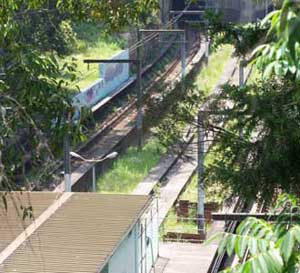
The station itself consists of a central eight-car length platform, which in fact is only the concrete foundations of full passenger platforms. Only at one end of the 'station', where electricity substations are housed, does the central platform resemble the other operational stations on the line. The tracks emerge at the 'Edgecliff end' of the abandoned station from a high sandstone wall, indicating that the former unused grassy area was half cut out of the natural topography. At the Bondi Junction end the tracks emerge from beneath a grassy hill sloping somewhat steeply down from an adjacent street. The tunnels at this point are clearly not far beneath the road and residential properties, as they curve to the south-east. The tracks themselves have a slight south-easterly curve.
The abandoned station is surrounded on one side by a row of backyard fences. While this is a common sight in Sydney's working class inner-west and inner-south, it is interesting to see the backyards of million dollar properties backing onto a heavy rail line just metres away. One the other side, the station is bordered by a large empty park-like area.
On this side, a long, steep, narrow block of vacant land exists, rising all the way up to Edgecliff Road. This is between two private properties, and is not accessible to the public. Records from the old Department of Railways would indicate that this was intended to be the location of an elevator to the grassy park-like area, which would have been completely landscaped, and was intended to house the ticketing office, entry barriers to the station, one or two small retail outlets, and an overhead bridge and staircase down to the platforms.
The platforms themselves would have been covered over with shelter, but it was not intended that they would be completely enclosed. Other entry points to the station would have been via escalator from the Edgecliff end, from Edgecliff Road, and from Wallaroy Road at the Bondi Junction end.
It is not known if the Department planned to resume any of the properties directly next to the tracks for further infrastructure works. The abandoned station is fully visible from a small grassy look-out off Edgecliff Road. The view from this look-out is extremely pleasant - not only can the viewer see the station and trains passing underneath, but the mini-CBD skyline of Bondi Junction to the south-east is fully visible in the distance - ironically the line's terminus building is also visible from this point. The station is also semi-visible from Wallaroy Road at the Bondi Junction end of the tracks.
 How the station would have looked
When the Eastern Suburbs Line was under construction in the 1960s and 1970s, the plan was to locate a station in a closed off grass cutting backing onto the backyards of properties on four surrounding streets. It is believed that the cutting had, for many years, been owned and preserved by the then NSW Department of Railways, as a future potential railway site. Local residents, unaware of this, would use the pleasant but enclosed grassy cutting as a hidden local park. The area, being surrounded by the high rocky escarpment that is Edgecliff Road, Woollahra, contained many trees and was a sanctuary for bird life.
The local residents, appalled to learn in the 1960s that the cutting would become a heavy railway station - to boot, the only above ground station on the line - lobbied the Government of New South Wales vigorously to oppose the station. In the meantime, construction work on the Eastern Suburbs line was slowing down due to various factors including the cost blow-outs of the project. With the Edgecliff Railway Station buildings and tunnels built by 1969, and the line all the way to Bondi Junction Railway Station not opening until 1979, this gave the residents of Woollahra plenty of time to organise their opposition to the station.
Notwithstanding the fact that, at the time, the station may have had low patronage, the local community took the NSW Government all the way to the High Court of Australia to oppose the opening of the station, an action that was lost. Despite construction work taking place, and the basic station infrastructure being constructed, community angst as well as the cost factors surrounding the project, eventually led the Government to abandon the idea of placing a functioning station there. Furthermore, the Government and Railways Department, now RailCorp taking into account the fact that the rail lines are within around five metres of suburban backyards, then went as far as to install silencing structures around the tracks. These concrete and steel silencers in fact created what is the quietest section of railway track in Australia, with trains gliding on by day and night, emitting only an eerie low hum as they pass through the cutting.
The Sydney Morning Herald has stated that this abandoned railway station is a prime example of a broken NSW government promise over the construction of rail infrastructure within Sydney. Furthermore it states that this abandoned station has contributed to the heavy congestion that we see today on Sydney roads as the housing density in this area is significantly greater than it was in the late 1970s.