


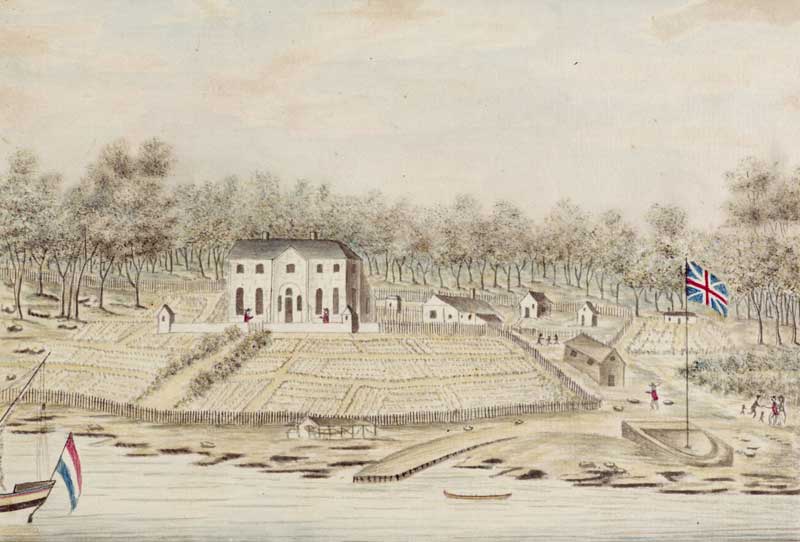
Government House, c.1792
Lost: 1st Government House
Location: Bridge, Street, SydneyThe first Government House Built on a rise on the east side of Tank Stream, the first Government House was the home, offices and seat of authority for the first nine Governors of New South Wales from 1788. A two storey building of classical Georgian style (symmetrical facade with an even number of windows on either side of the centrally located door), its floorplan is believed to have been modelled on Captain Arthur Phillip's former home, Vernalls farm, at Lyndhurst in Hampshire, England.
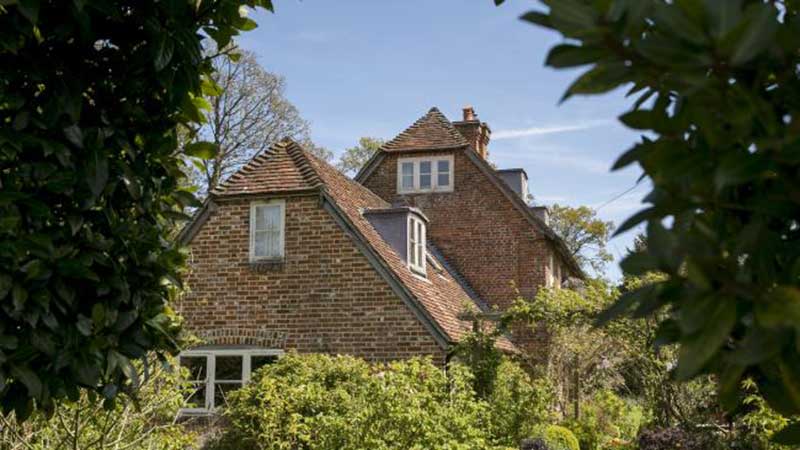
Vernalls farm
Constructed by convict bricklayer James Bloodsworth, it was poorly designed and had a limited lifespan and had to be demolished in 1845. 5,000 bricks were brought out from England and used in its construction. These were supplemented by some of the first bricks to come from the kilns of Brickfield, the n 8ame given to the locality where clay deposits were first found. In all probability, 25 year old convict William Edwards, the colony's only brickmaker by trade, would have been put in charge of the brickmaking facility, with a number of unskilled labourers assigned to work under him.
 First Government House c. 1840. Artist not noted. Historic Houses Trust
On the right is the wall coming down to the water's edge from the Bridge St gates. That is the Government Wharf jutting out.And then it goes around the shoreline until it cuts back up the hill about where Opera Bar is today, where the Governor's "private" wharf was. On the inside of the wall rode Mrs Macquarie in her carriage, and on the outside of the wall the hoi-poloi perambulated. The windmill was known as Palmer's Mill.
On 4th June 1788, a grand opening of the building was held at which time the birthday of King George III was also celebrated. After the building's completion, a number of brick outbuildings were erected nearby and used as barracks, workshops and for storage. First Government House and its service buildings were demolished in 1846 and the bricks and other building materials sold at auction. Mitchell Library holds one of the bricks. Shortly thereafter, Phillip Street was realigned and extended to the newly reclaimed Circular Quay, so that it ran across some of the First Government House foundations"
In 1983, archaeologists unearthed the original footings of the house, which by a miracle of history, had lain preserved since it was demolished. These remains are a feature at the Museum of Sydney in Bridge Street which is erected on the site of the building.
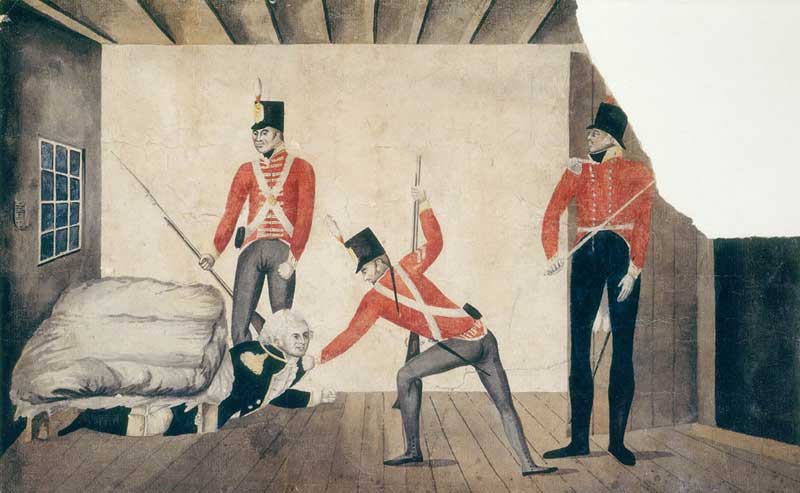
It was at the first Government House that the then-governor, Gov. William Bligh, was arrested in what became known as the Rum Rebellion. Governor Bligh and Colonist John Macarthur were two very stubborn men, equally sure of their own rightness, and were perhaps doomed to conflict with each other.
In the beginning of 1808, Bligh arrested Macarthur over his previous actions in resisting a warrant. The Captain of the NSW Corps, George Johnston, ordered Macarthur's release. When Bligh refused, Johnston marched on Government House, deposed Bligh and took command, giving Macarthur the post of Colonial Secretary. Johnston was subsequently court-martialled.